
Let’s pretend you are a marketer for a large consumer brand. You plan to launch an email newsletter. You call it “Spam the Newsletter.”
You’d never do that, right?
It’s like a grammarian named “Typo.” Or a hopeful politician with the name “Loser.”
But let’s pretend you did call it Spam—you really did!
And when you write your first issue you misspell your CEOs name (twice). (You address your newly acquired subscribers as “FIRSTNAME LASTNAME” (literally—that’s the “name” you use).)
(Pause here to check if all those parenthetical asides are parenthetically closed correctly. Yes? Yes! Onward.)
* * *
What’s the best way to get subscribers to your fresh new newsletter named Spam?
- Create a viral Twitter thread followed by a CTA like Sign Up for More of This Brilliance Or Die Penniless and Alone.
- Display an aggressive website pop-over that assaults anyone whose cursor hovers within a hair of the browser address bar.
- Buy a giant billboard (a billboard!) in the heart of NYC, with a self-effacing invitation to subscribe. (Did you catch that? A! BILLBOARD!) Put similar giant messaging in the London Tube and on billboards and outdoor and digital displays globally.
* * *
If you’re oatmilk company Oatly, you choose billboards.
Because you actually have created an email newsletter named Spam. And last week you invented a week-long festival (“Spam Week”) to promote new signups via outdoor and display worldwide. You papered tube stations and billboards like a deranged evangelist.
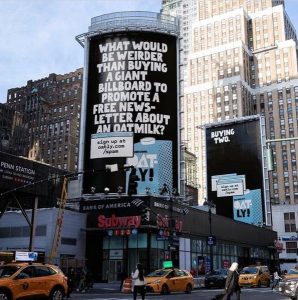
It runs counter to everything we know in Marketing. It’s weird and subversive. And so of course I had to find out more. I called Oatly.
* * *
Kevin Lynch is Creative Director at Oatly. Here’s a condensed version of our conversation, with my observations throughout.
ANN: What do you think you’re doing? Why? How?
KEVIN: Someone said to someone else, “Wouldn’t it be funny if…” and laughter ensued.
The global campaign for the newsletter came about in the same way: Someone said to someone else, “Wouldn’t it be even funnier if…”
We should probably come up with a more detailed backstory that includes user journeys, market analysis, and internal processes, dropping vague references about ChatGPT or Web3 along the way.
Truth be told, we’re just very bad at complicating things.
➡️ Takeaway for all of us non-Oatly marketers: Think differently. Think big! Ask: “What if…?”
Yes, even you.
The best ideas come from the most unhinged places. If an idea hits as insane… it’s probably worth probing.
Give yourself (and your team) the freedom and permission to wade into the Forest of the Shadowy Unknown.
Peek in the shadows. Turn over the rocks. Find the Weird Idea Monster in his cave. Make friends with him. (Stroke the Weird Monster’s underbelly.)
Germinate those ideas (the ridiculous Crazy Idea Seeds) under a grow light.
Maybe they won’t thrive. But maybe they will. Maybe you’ll back out of the Forest and scurry back to safety, but still you’ll be changed.
You’ll never know unless you set a tone of FREAKY WELCOMED HERE.
➡️ Another takeaway: User journeys and market analysis… all great.
But there is no page in the leather-bound Encyclopedia of Data (Volumes 1-52) that will point you to naming an email newsletter Spam and promoting it via outdoor.
What also matters is your creative sensibility (gut, heart, brave moments you spent sitting quietly in the cave with the Weird Idea Monster).
ANN: Tell me about the strategy. In subways, billboards… you aren’t marketing the brand. You’re marketing the newsletter. Why?
KEVIN: We look at it as a brand awareness campaign that happens to end with subscribers.
Because honestly, it’s the same as a typical Oatly brand campaign.
Same brand voice. Same product shot. Same lack of useful information.
➡️ Takeaway for us: This strategy is interesting. I wish we used it more often in brand marketing/advertising:
Offer value—not just that the brand exists.
Oatly is trading on the idea that it’s weird to promote a newsletter on a billboard—which is fun and oddball in and of itself.
But if I had Kevin’s job, I’d next push it further—maybe leak out the content of the next issue? IDK, exactly. I’d need to stroke the Monster’s Underbelly a little. (LOL sorry)
BTW, I asked Kevin how many signups the campaign earned the Oatly newsletter. He said they aren’t sharing.
ANN: How would you describe Spam the Newsletter & Oatly’s brand voice?
KEVIN: John Schoolcraft, whose title is unclear but who seems to be in charge of a lot of things around here, likes to say Oatly is one of the world’s most unexplainable brands. We’re pretty sure he’s using that to avoid answering questions.
But the fact is we have no brand guide. We have a few beliefs you hear a lot: We like to be “consistently inconsistent.” And we try to make sure the brand acts “like a human, not a company.”
Beyond that, for those of us who came along after the brand was already established, there’s not really any guideposts to help get comfortable with the brand voice.
We just keep bumping into things until we find our way to the end or until the lab technician decides to turn on the lights and end the experiment. Whichever comes first.
➡️ Takeaway for us: “No brand guide.” Did that stop you, too?
How does a public, global company in a hypercompetitive field with a market cap of $1.23 billion bump around in the dark… ON. PURPOSE?
Despite what Kevin told me, I think their brand voice actually is explainable. I don’t want to bog us down here in the middle of our convo with Kevin. But I’ll define it how I see it—in the Everybody Writes section below.
Let’s keep going…
ANN: You got some heat for Spam week, particularly on Reddit, which is famously hostile to brands and advertising, but specifically irritated at Oatly.*
* Side note: Reddit user faghaghag wrote:
“your advertising campaigns are consistently the most grating and pathetic faux-cool bullshit. I am actively hostile toward your brand.”
Faghaghag was so mad at Oatly that they even didn’t capitalize the y in “your” in the first sentence. Brutal.
KEVIN: I think this brand’s commitment to act fearless is one of its most unassailable advantages. I really don’t understand the level of fear marketers have about drawing criticism.
Why not look at criticism as a sign that people care, and treat it as only the beginning of a conversation?
We don’t necessarily wish to be hated.
But being ignored—now that’s something to fear.
* * *
I love Kevin’s last line, which reads like a mic-drop. This is the signup for Spam by Oatly, by the way. If you want to check it out.