
A version of this story appeared in Total Annarchy, my fortnightly newsletter that helps you be a better writer, storyteller, marketer. Get it in your inbox; you’ll love it.
***
Since September is the first month of a new year (we all agreed), it’s the perfect month to start writing my new book! (More specifics on it later.)
My writing goal is 1,000 words per day—or 1K A Day. I laced up for this 1K Word Sprint just after Labor Day.
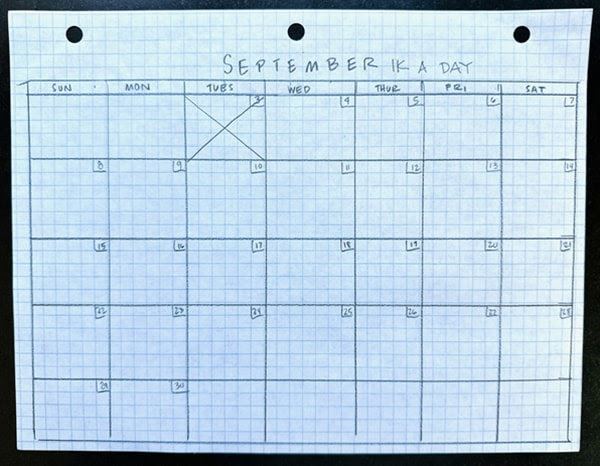
I get up every morning. I sit. I write. I ignore everything else. That tracking sheet above…? ALL Xs, baybee!
Already, I’ve learned some things about showing up every day and doing the work. It applies to my book. But also to any big project you might have.
>>> Protect your peak time like the door bouncer at an exclusive club.
Most of us have only a few good hours for hard, creative work. Peak time for me = mornings. I boot out morning meetings like they are underage partiers, moving them to the afternoon or canceling entirely. (It’s true what the memes say: Some meetings really could be emails.)
Real-real talk: I realize that’s a privileged position not everyone has—to reshape a schedule according to creative peak times. Maybe you have only an hour you can spare. Then do what you can. The key is to find as much consistent time as you can to fuel the habit. The author Anthony Trollope famously wrote for 3 hours every morning before heading to his job at the post office.
Showing up once a week is an obligation, not a habit. Be like Anthony.
>>> Have the bouncer boot out open email tabs, social media, anything that siphons your attention.
You can deal with all that later. Right now, you have one job.
>>> Set a goal. Aim for some kind of North Star each day. But! And here was a surprise…
>>> Realize that the goal will be arbitrary at times. Showing up is more important than hitting a goal.
>>> The hardest part is writing the first word; after that, the other 999 flow. The hardest part is adhering peach 🍑 to seat.
>> One more thing about momentum. “Butt in chair. That’s the piece of direction I give to anyone and everyone who wants to write, who is thinking about writing, who is asking how it’s done, who is fearful of and intimidated by the act,” writes Anna Quindlen.
We want it to be magic. We want it to be poetic and divine, mindful and demure. It’s not. It’s as ordinary as building a house, one 2×4 at a time.
>>> Treat discouraging moments as marathon cramps. Push through the pain and eventually it goes away. Author Nat Eliason shared that.
It’s counter to how I typically would work: Cramps? I tap out. Sit on the bench. Hydrate. Go stare at the open fridge.
But these morning 1K sprints are short enough that running through the cramps ultimately leads to a better session + happier me. But there’s a method…
>>> Mix up analog and digital. We write on laptops. I am, too, guided by a fat, 40-page book outline. But when I get stuck—seized up from a cramp—I switch from digital to analog.
It happened yesterday: I spent close to 90 minutes working with a pencil and paper trying to rework a framework that wasn’t sitting right with me.
It’s not either digital or analog. It’s both. They light up different parts of our brains.
>>> Imperfect thoughts. In Everybody Writes, we talk a lot about The Ugly First Draft. But working with new material in new ways… there’s a moment before the Ugly: The Imperfect Thoughts.
The half-baked ideas. The brain tangents that may or may not be a thing. I capture them anyway, as they occur, in the margins of my work.
Might delete later. Might actually be a thing. That’s a decision that Future Me will make.
>>> Motivational quotes are not cheesy; my door bouncer will fight you on that.
Olympic swimmer Regan Smith medaled in Paris; inside her cap is printed this quote: Bet on you. I adopted Regan Smith’s mantra as my own.
Maybe you and I aren’t breaking the American record in the 200-meter butterfly, like Regan did in Paris. But we are breaking new ground for ourselves.
(I’m resisting further cheesy-ing this point by commenting on how betting on yourself takes you from cocoon to butterfly because swimming, see, but now this whole metaphor is… sunk.)

>>> A two-desk method. I set up two places to work: one for 1K A Day book writing, the second for everything else. The first is inside the house; the second is my Tiny House Studio.
You don’t need two separate locations. Maybe one is a coffee shop or a library. Even two ends of a table will do. The important part is to eliminate friction to slip right into writing/not writing.
>>> Plan Wednesday on Tuesday. The most frustrating day I had was when I finished on a high note. Yet the next day, I was unsure where to start. I wasted an hour when I was gung-ho and freshest… trying to decide the best starting point. Annoying.
Spend the last few minutes of one day planning what you’ll dig into the following day. The flow will flow more freely.
>>> Weekends, too. This one is the hardest for me. But since I worry a two-day break would kill my momentum, I’m including weekends, too. For now, anyway. Check in with me in October.
>>> Pencil & paper tracking = deeply satisfying. I’ve tried a million productivity tracking tools. But the simplest approach just… works. It’s weirdly wonderful to cross off a box each day. Human brains are wild, aren’t they?
If you’re working on a big project this new year (!) too… Join me in my 1K A Day program!
There’s no signup. There’s no real accountability. Just the quiet security of knowing that we aren’t alone.